Working With Indoor termination kits Inside Live Substations
- pcatechnologies01
- Dec 9, 2025
- 6 min read
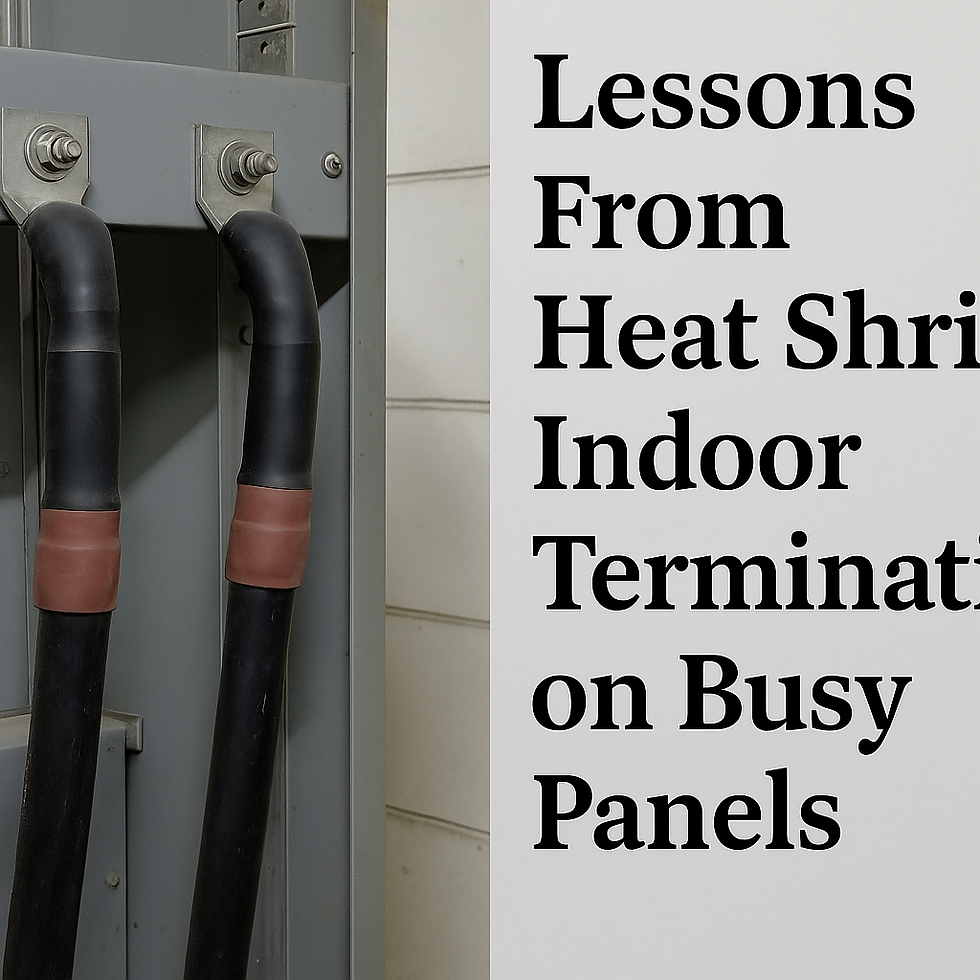
Indoor electrical rooms rarely feel calm when you are the one making the final connections. This article shares real site observations on indoor termination kits, touch-proof screened separable connectors, GIS bushing interfaces, transformer bushings, and the daily role of a digital clamp meter. These are not textbook explanations. This is about how equipment behaves after years of heat, vibration, dust, and human decisions. Written from the installer’s side of the panel, where small choices quietly shape whether systems stay stable or slowly drift toward failure.
Indoor substations never feel truly silent. There is always a low hum under the concrete, a faint vibration in the panel walls, and that warm electrical smell that doesn’t belong to any single cable. People who haven’t worked inside one think everything is controlled. No rain. No wind. No sun. But the pressure inside these rooms comes from somewhere else.
It comes from tight spaces, live neighbors, aging equipment, and the knowledge that once you close that panel, the connection may not be seen again for a decade.
That is where indoor termination kits prove what they are made of. Not on a desk. Not in a catalog. But inside rooms where cables curve the wrong way and deadlines arrive before conditions are ready.
Indoor Work Feels Safer Until You Are Actually Standing There
People assume indoor means safe. It doesn’t always feel that way when you’re bent over a termination with your shoulder brushing a warm enclosure.
Space Shrinks Faster Than Drawings Suggest
The drawings always show clear space around the cable entry. On site, the cable tray sits lower than expected, the back wall is closer than planned, and the protective barriers block half your working angle. You learn quickly that your hands will work at strange positions, and heat will rise toward places you don’t want it to.
When sliding components from indoor kits over thick cables inside such spaces, you stop thinking about neatness. You start thinking about friction and clearance.
Indoor Heat Has Nowhere to Escape
Outside, heat drifts into the wind. Inside, it gathers. When multiple terminations are being shrunk in a small room, the air itself warms. Gloves get damp. Shrink tubes recover faster than expected. This changes timing. A slow worker outdoors can become a rushed worker indoors without realizing it.
What Indoor termination kits Really Have to Tolerate
The contents of a kit look simple at first glance. Tubes, sleeves, stress layers, sealing sections. On site, each piece becomes part of a chain that either holds together under years of service or quietly comes undone.
Cable Aging Is the First Surprise
New cables behave politely. Old ones rarely do. Insulation stiffens. Sheathing becomes uneven. When you try to slide controlled components over aged insulation, they resist at the worst point, usually right where access is poorest.
Many installers learn the hard way that forcing parts into place creates invisible scars. Those scars may not show up during testing. They reveal themselves during thermal loading months later.
Bend Memory Never Fully Goes Away
Cables remember how they were stored. Even after straightening, that memory hides inside the conductor. Termination components must fight that tension for years. Weak sealing always gives in first.
Touch-Proof Screened Separable Connectors in Real Rooms
On paper, Touch-Proof Screened Separable Connectors sound comforting. In real rooms, they come with expectations that reality does not always fulfill automatically.
Cleanliness Matters More Than Most Admit
Every dust particle on the interface becomes part of the insulation system once the connector mates. Indoor rooms are not clean rooms. Sweeping helps, but fine dust floats in through cable trenches and ventilation paths.
A connector can be perfectly installed and still fail prematurely because of contamination that no one noticed at the moment of assembly.
Alignment Is Quietly Critical
Separable connectors demand straight entry. In tight rooms, cables often approach at a slight angle. Even a few degrees of misalignment can create uneven contact pressure inside the mating zone. That pressure difference may not show electrically at first. Mechanically, it never forgets.
GIS Bushing Interfaces Are Less Forgiving Than They Look
Gas-insulated switchgear creates an impression of sealed perfection. The truth is that the interface between cable and GIS bushing depends heavily on human hands.
Surface Condition Is Everything
A faint scratch on a GIS bushing surface feels harmless until you realize that stress concentration lives exactly there. Most installers don’t cause damage intentionally. It happens during lifting, shifting, or hurried positioning.
Later, when partial discharge appears, everyone traces the problem electrically. Few trace it mechanically back to a small surface wound.
Pressure Is Hard to Judge by Feel Alone
Some couplings need firm engagement. Others demand delicate seating. Experience teaches the difference. Over-tightening feels safe in the moment. Over time, it introduces new stress patterns that insulation slowly reacts against.
Transformer Bushings Carry Both Load and Memory
Transformer bushings hold both electrical and emotional history. They remember past faults. They remember overloads. They remember vibration.
Mechanical Disturbance During Termination Work
During cable movement, even careful handling transmits small forces to bushings. Those forces are rarely enough to damage anything instantly. But they shift stress distribution.
Over years, that shift becomes part of the insulation aging process. Nothing dramatic. Just gradual change.
Sealing Zones Age Quietly
Oil-filled bushings expose installers to sealing zones that look firm and dry. Internally, temperature cycles work on them every day. External moisture doesn’t rush in. It creeps.
Termination quality determines how easily that creep succeeds.
The Digital Clamp Meter as a Habit Not a Tool
Most people see the digital clamp meter as a measuring device. On site, it becomes more than that. It becomes a habit.
Post-Termination Readings Are Personal Reassurance
No one fully trusts visual inspection alone. Once terminations are complete, the clamp meter comes out almost by instinct. Phase balance tells a story. Load difference hints at mechanical unevenness that the eyes miss.
It’s not paranoia. It’s pattern recognition built through mistakes.
Trending Matters More Than One-Time Values
A single current reading means little on its own. Repeated readings over weeks tell a narrative. A slow rise on one phase often begins long before insulation trouble becomes visible.
Why Indoor Failures Rarely Arrive With Drama
Indoor electrical failures are often disappointingly quiet.
No explosion No arc flash No public spectacle.
Just a growing odor. A warm patch on thermal imaging. A breaker that trips “for no clear reason.”
By the time troubleshooting begins, the issue has usually been developing for months.
Human Pressure Shapes Technical Outcomes
The weakest link in any termination system is rarely the material. It is always pressure. Schedule pressure. Staffing pressure. Operational pressure.
When Energization Deadlines Take Control
There is always a moment when someone asks, “Is it really necessary to wait?” That moment decides the future of many terminations. Waiting allows shrink to settle. Rushing locks heat inside layers that are not ready.
The difference may not appear until the season changes.
Indoor Does Not Mean Dry Forever
Humidity enters buildings in quiet ways. Through cable ducts. Through personnel doors. Through ventilation systems that cycle with weather.
Shrink sleeves and connector seals fight humidity constantly. They win only when they were installed without shortcuts.
Rework Teaches What Training Cannot
The most painful training comes from reopening failed terminations.
You see where stress built you see where moisture tracked You see where alignment drifted.
And you remember the moment when you thought, “That should be fine.”
The Hidden Load of Vibration and Sound
Indoor equipment vibrates even when it sounds still. Transformers hum. Switchgear breathes. This vibration is small but relentless.
Insulation experiences millions of tiny movements. Good termination absorbs. Poor termination resists. And resistance always cracks first.
Clean Panels Age Better Than Busy Ones
Panels with simplified routing, disciplined bundling, and careful separation age gracefully. Busy panels age noisily. Hot spots form earlier. Troubleshooting becomes guesswork.
The difference is rarely cost. It is behavior.
The Psychological Shift After a First Major Indoor Fault
After the first serious fault you witness inside a controlled room, your work changes. Hands slow down. Heat time extends. Cleaning improves.
Fear fades. Respect grows.
When Temporary Decisions Become Long-Term Architecture
Temporary supports become permanent. Temporary routing becomes permanent. Temporary insulation layers stay in service far beyond their intended life.
Indoor systems carry a hidden history of decisions that were never meant to last.
What Experienced Installers Watch That New Ones Ignore
They watch cable tension after shrink.They watch subtle misalignment at interfaces.They listen to sound changes in transformers.
These are instincts built from failure, not from manuals.
Testing Feels Complete But It Is Only a Beginning
Insulation resistance values look comforting. Continuity checks pass. Phase sequence aligns.
But testing only confirms the present. It does not confirm endurance.
The Quiet Rules No One Writes Down
Never heat where you cannot see.Never trust dryness without wiping.Never assume alignment from one angle.Never rush sealing steps.
These rules live in memory, not in procedures.
When Silence Is the Only Feedback You Get
There is a special silence after energization. When breakers hold. When meters settle. When nothing changes.
That silence is the closest thing to approval this work ever offers.
Final Conclusion
Indoor electrical rooms hide complexity behind concrete walls and neat panels. Indoor termination kits, touch-proof screened separable connectors, GIS bushing interfaces, transformer bushing, and the daily use of a digital clamp meter all depend far more on installer behavior than on specifications. The work succeeds not through speed or perfection, but through patience, surface care, quiet alignment, and respect for slow mechanical forces that never stop acting. The best installations are not the ones people praise. They are the ones no one talks about for years.


Comments